

Business Process Automation
Work Smarter
With Hyperautomation
Business process automation allows companies to move away from manual processes and build more efficient, data-driven operations. By integrating workflow automation, AI automation solutions, and management intelligence, we help teams work faster, reduce errors, and gain visibility across all business processes.

Operational Complexity Slowing Down Your Business?
Many organisations start thinking about business process automation when daily operations become difficult to manage. As companies grow, processes expand across multiple systems, reports take longer to prepare, and teams spend more time transferring information between platforms instead of focusing on valuable work.
Hyperautomation helps organisations transform fragmented processes into connected systems where workflows, data and reporting operate automatically. Business process automation typically becomes necessary when organisations experience challenges such as:
-
Your team spends a large part of their working time on manual data entry and process management.
-
Important information is scattered across several systems, making it difficult to see the big picture and make data-driven decisions.
-
Reports are prepared manually and take too long.
-
As the business grows, processes become more numerous and complex, making them increasingly difficult to manage.

Hyperautomation
Solutions We Build
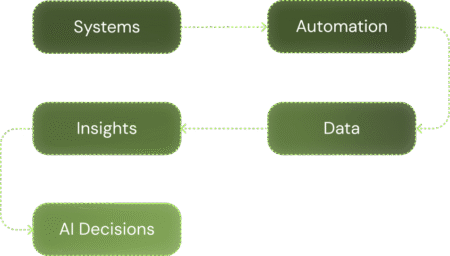
Our hyperautomation framework combines four core layers that together create a fully connected operational system.
AI & Workflow Automation
We automate repetitive business processes – from document processing to internal workflow management. AI workflow automation ensures that tasks, approvals, and data transfers between systems happen automatically and consistently.
about AI & Workflow AutomationCustom Business Applications
When standard tools are no longer sufficient, we develop custom business applications tailored to your organisation’s processes. These internal systems connect operations, CRM, and data flows into a unified business environment.
about Custom Business ApplicationsPower BI & Management Intelligence
Power BI dashboards transform operational data into management intelligence to clearly see key business indicators and make data-driven decisions. Executives can monitor performance, financial indicators, and operational KPIs in real time.
about Power BI & Management IntelligenceAutomation & Reporting
Move from Excel-based reporting to an automated, data-driven operations model: we automate data collection and reporting, ensuring that business data flows automatically between systems and is always ready for analysis and decision-making.
about Automation & ReportingWhat Is Hyperautomation?
This architecture allows organisations to move from isolated automation tools to a fully connected hyperautomation system.
Hyperautomation is a method used to combine different business systems into a single functioning structure where operations are fully automated and data is always easily accessible. The most obvious benefit of such an enterprise automation platform is the ability to move from fragmented automated solutions to a consistent digital process automation model.
How does hyperautomation work? Many companies already automate individual processes – CRM systems register customers, accounting software generates invoices, but reporting still happens manually in Excel. Hyperautomation connects these processes into one system where data moves automatically between platforms and reporting becomes real-time.

Hyperautomation Vs Automation
Traditional Automation
One specific process is automated
Processes often remain isolated
Employees still transfer information between systems
Reports are often prepared manually
Automation makes work easier
Hyperautomation
Entire process chain is automated
Processes are integrated into a system
Information is transferred between systems automatically
Data and results are visible in realtime
Hyperautomation changes the entire way processes work
How Enterprise Hyperautomation Will Change Your Business
-
Processes run without constant supervision. Daily operations take place automatically, allowing teams to devote their time to more important, high-expertise tasks.
-
Operational costs decrease as manual administrative work is replaced by automated workflows.
-
Decisions no longer require waiting for reports. Executives can view key business metrics in real time and respond more quickly to changes.
-
Fewer errors in daily processes. Digital process automation reduces manual work and helps prevent data transfer errors.
-
Processes remain manageable even as the business grows. Thanks to AI hyperautomation, new customers, projects, or teams can be integrated into an existing system.
-
A clearer picture of the entire organisation’s activities. Data from different systems is combined, making it easier to understand what is happening across the entire business.
About Us
Hyperautomation Solutions
with AutomationCore
AutomationCore is a team specializing in business process automation, AI hyperautomation, and data-driven operations. Our team combines automation architecture, data integration, and Microsoft Power Platform expertise to build scalable hyperautomation solutions for European enterprises. Our mission is to connect business systems, automate processes, and help organisations create a more clearly managed operational structure.
We work with companies whose processes are becoming too complex to manage manually, where information is scattered across multiple systems, and key business metrics are not easily accessible.
Feeling like your team is spending too much time on manual processes and different systems aren’t working together as one? It’s probably time to think about business process automation – let’s discuss it together.
We develop solutions in the Microsoft ecosystem using Power Automate, Power Apps, and Power BI. This allows us to combine automation, business systems, and data analysis into a single platform that can grow with your organisation.
We bring more than 10 years of experience working with complex operational systems, particularly in the energy and infrastructure sectors, where large-scale data integration and system automation are essential.

Power Automate

Power Apps

Power BI

Why
Choose Us
Clarity
We help businesses understand how and where hyperautomation could create the most value.
Practicality
We build solutions that work in real business operations – not just in theory, but in everyday tasks.
Long-term Value
We create solutions that remain useful as the organisation grows and can be scaled with your business.
Ready for Enterprise Automation?
Automation & Data Audit will give you insight into how your business processes work today and where enterprise automation solutions would create the most value.
During the audit, we evaluate your processes, systems, and data flows so we can offer a clear roadmap for transitioning to a more efficient enterprise automation platform and stronger data-driven operations.
Have any questions or need a consultation?
Get in touch before booking an audit.
FAQ
Business process automation allows organisations to reduce manual work and manage daily operations more efficiently. This means that the entire business process (for example, from receiving a customer inquiry to issuing an invoice or completing a project) can be automated and executed without constant manual intervention.
By automating processes, different systems can exchange data automatically, eliminating the need for employees to manually transfer information or perform repetitive tasks that do not require expert knowledge (e.g., administrative tasks). Implemented business process automation allows organisations to create more efficient processes, reduce the number of errors, and better control operations.
The main benefit of business process automation is more efficient and clearly managed operations. Automated processes reduce manual work, speed up information processing, and allow organisations to better control the entire business process flow, from task distribution to the final result.
In addition, automation helps organisations transition to data-driven operations, where decisions are made based on real data rather than assumptions.
Workflow automation is the automation of steps in a specific work process, where tasks are performed automatically according to set rules. Workflow refers to a sequence of tasks – for example, when a document needs to be approved by several people, when customer data is transferred between systems, or when the system automatically assigns tasks to team members.
Workflow automation is usually part of business process automation. It helps to ensure that processes run consistently, according to a set procedure and without manual intervention.
Workflow automation enables organisations to manage daily processes more efficiently and reduce manual work. Automated workflow processes ensure that each step of the process – from task creation to completion – occurs automatically and in the correct sequence.
This also contributes to operational efficiency automation, as employees can devote more time to more important tasks, while repetitive processes occur automatically.
Hyperautomation is a more advanced automation method that allows different business systems, processes, and data to be combined into a single functioning structure. Unlike individual automation, hyperautomation solutions automate not just one process, but an entire ecosystem of processes. Organisations are increasingly using an intelligent hyperautomation model, which combines automation with artificial intelligence and data analysis to enable better business decisions.
Hyperautomation examples in business can be very diverse. For example, customer data is automatically transferred from CRM to the accounting system, invoices are generated, and managers can see sales results in real time. Such systems often use AI decision support systems, which help analyse data and generate automation-driven insights that enable better decision-making.
Modern enterprise automation systems enable organisations to collect and analyse data from different business systems in one place. These indicators can be viewed in real time, allowing those responsible to see the results exactly when they need them and make decisions accordingly if certain challenges arise. This means that hyperautomation enables faster responses – not according to a predefined reporting schedule, but when a decision is needed immediately.
AutomationCore specializes in business process automation, AI, and data-driven operational solutions. We are your hyperautomation partner, helping you connect processes, systems, and data into a single functioning structure. Our goal is to help organisations implement enterprise automation solutions that enable more efficient operational management.
When implementing projects, we first analyse the organisation’s processes and existing systems, usually starting with Automation & Data Audit. Then we create a suitable enterprise automation architecture that allows us to connect different platforms and automate processes. Once the architecture is created, the system is implemented and tested, and we await your feedback during the process. If necessary, solutions are further improved and adapted.
Companies usually start considering automation consulting services when processes become too complex to manage manually or when different systems do not work as a single structure. In such situations, automation experts can help create more efficient processes and implement operational efficiency automation, allowing the organisation to operate faster and more accurately.
During Automation & Data Audit, we analyse the organisation’s processes, systems, and data flows. This allows us to understand where automation could create the most value. The result of the audit is a clear recommendation on how the organisation can transition to a more effective enterprise automation platform and strengthen data-driven operations. If you decide to hyper-automate your business processes in the future, the audit results will become a clear action plan on where to start and what steps to take.